The Sympathizer’s confession manuscript
The SympathizerThe Sympathizer’s confession manuscript is the record through which the unnamed narrator is ordered to account for his life, but it is also a contested object: The Commandant edits it, the unnamed narrator is made to copy it, and its final pages turn toward the violence of the examination itself. The 295-page document does not simply disclose a settled past. Its changing form exposes the difference between confessing facts and producing the kind of confession those in power will accept.
Composition and Confinement
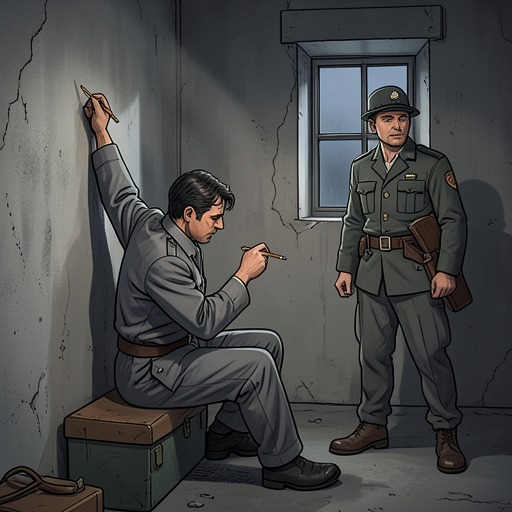
The unnamed narrator writes the confession during a year of isolation after the ambush. His cell is windowless and redbrick; when The Commandant receives the latest version, it consists of a final sheet laid atop 294 preceding pages. The manuscript’s scale records time spent revising, but not progress toward a version that satisfies its examiners. The Commandant has kept earlier drafts under scrutiny and treats the text as work still subject to correction: he marks errata and digressions with a blue pencil, which he says Stalin also used, and urges the unnamed narrator to delete, excise, reword, or add.
That editing makes the manuscript an instrument of confinement as well as its product. The unnamed narrator has not spoken to anyone for a week when he is summoned to discuss the latest pages. The Commandant insists that he is not a prisoner but a special guest, even though the unnamed narrator has just spent the preceding hour in the isolation cell and has been held there for a year. The discrepancy between the reassuring label and the conditions of writing gives the confession its coercive setting: the unnamed narrator is required to describe himself while another person controls both his surroundings and the standards by which his account will be judged.
The Demand for a Different Confession
The Commandant says the confession is a necessary prelude to a cure, yet considers it unsatisfactory. Other inmates, he reports, have adopted familiar descriptions of themselves as puppet soldiers, imperialist lackeys, brainwashed stooges, colonized compradors, or treacherous henchmen. He distrusts those formulas as what he expects to hear, while the unnamed narrator’s refusal to provide the expected account leaves his intelligence or foolishness open to question. The manuscript therefore fails not because it contains no admissions, but because its author has not made those admissions in the required manner.
The Commandant makes the distinction explicit: content may be present, but style is not. He invokes the Red Guards as evidence that confession depends on a particular way with words. In this exchange, editorial correction becomes political judgment. The manuscript is not evaluated solely as a record of what happened; it must take a form that makes its writer legible to the authorities. The unnamed narrator says he takes the criticism seriously, but even his willingness to revise does not resolve the disagreement over what a genuine confession should sound like.
The problem of what the manuscript leaves out becomes sharper when its examiners point to The Communist Agent. The Commandant’s voice cites a passage about her espionage evidence being crammed into her mouth and notes that she appears several times in the confession. The text records the unnamed narrator pulling a list from her mouth and seeing her hatred, but does not disclose her fate. When challenged, he says he did nothing to her. The exchange makes omission itself a subject of examination: the manuscript’s repeated references have not supplied the account its readers demand, and the gap cannot be closed merely by insisting that nothing happened.
Copying and Recovery
After the examination, the unnamed narrator is returned to his former cell, now unlocked and without shackles, but he remains withdrawn, silent, and disoriented. His eyes are sensitive to sunlight after conjunctivitis; he sleeps or sits in the corner, and when The Commandant asks whether he is still saying nothing, he repeats that he is. The doctor proposes a familiar activity as a way back to himself: writing is no longer possible, he suggests, but copying may be manageable.
The doctor gives him the confession, a numbered stack of 295 pages, and a second stack of blank paper with pens. The unnamed narrator begins by staring for hours at the first blank page. At first he can copy only a few words an hour; gradually he manages a page, then several pages in an hour. The work takes months. As he copies, the confession becomes more than a document under review: its words make him follow the course of his own life again. He develops sympathy for the intelligence operative represented in its pages and revisits the questions the manuscript cannot settle, including whether that man chose the right side of history.
Finishing the copy does not mean that the existing pages contain all that needs to be said. With enough of his senses restored to recognize that the answers are not in the confession, the unnamed narrator asks the doctor for more paper. He writes new pages about what was done to him in the examination room. The manuscript thus grows beyond its original account: it now records not only the life that brought him to confinement but also the violence carried out in the name of completing his reeducation.
Completion and Transfer
Once the new pages are written, the unnamed narrator asks to see Man again. He understands Man as both the commissar who has subjected him to pain and his friend and confidant; he also imagines that Man may be conflicted about what was done. The manuscript does not erase that contradiction. Instead, the unnamed narrator’s account of the examination leads him to feel sympathy not only for the person who suffered but also for the person who inflicted it. Writing supplies no simple acquittal: it gives him a way to hold both positions in view.
At their final meeting, Man studies the new pages and tells the unnamed narrator that he and Bon are leaving both the camp and the country. Before they go, Man picks up their manuscript—the copy of the confession together with everything written after it—and tells them that what happened in the examination room is between them. He puts the pages in their rucksack despite their attempt to refuse. In this last transfer, the manuscript changes hands from the institution that demanded and judged a confession to the two men departing its control. It remains a record shaped by coercion, revision, omission, and pain, but it also carries the unnamed narrator’s account beyond the camp.